
Installation and configuring plug-in Price Manager
The plugin changes the prices of your products in bulk. You can import prices from a CSV file, export them to a CSV file, or copy and change them right in the admin area: price, old price, product cost and tier prices.
It's easy to configure the plugin. See pictures.
1. Open the plugin from the admin menu: FoxNetSoft > Price Manager.
The page has five tabs: 'Import', 'Simple Import', 'Export', 'Copy/Update' and 'Settings'.
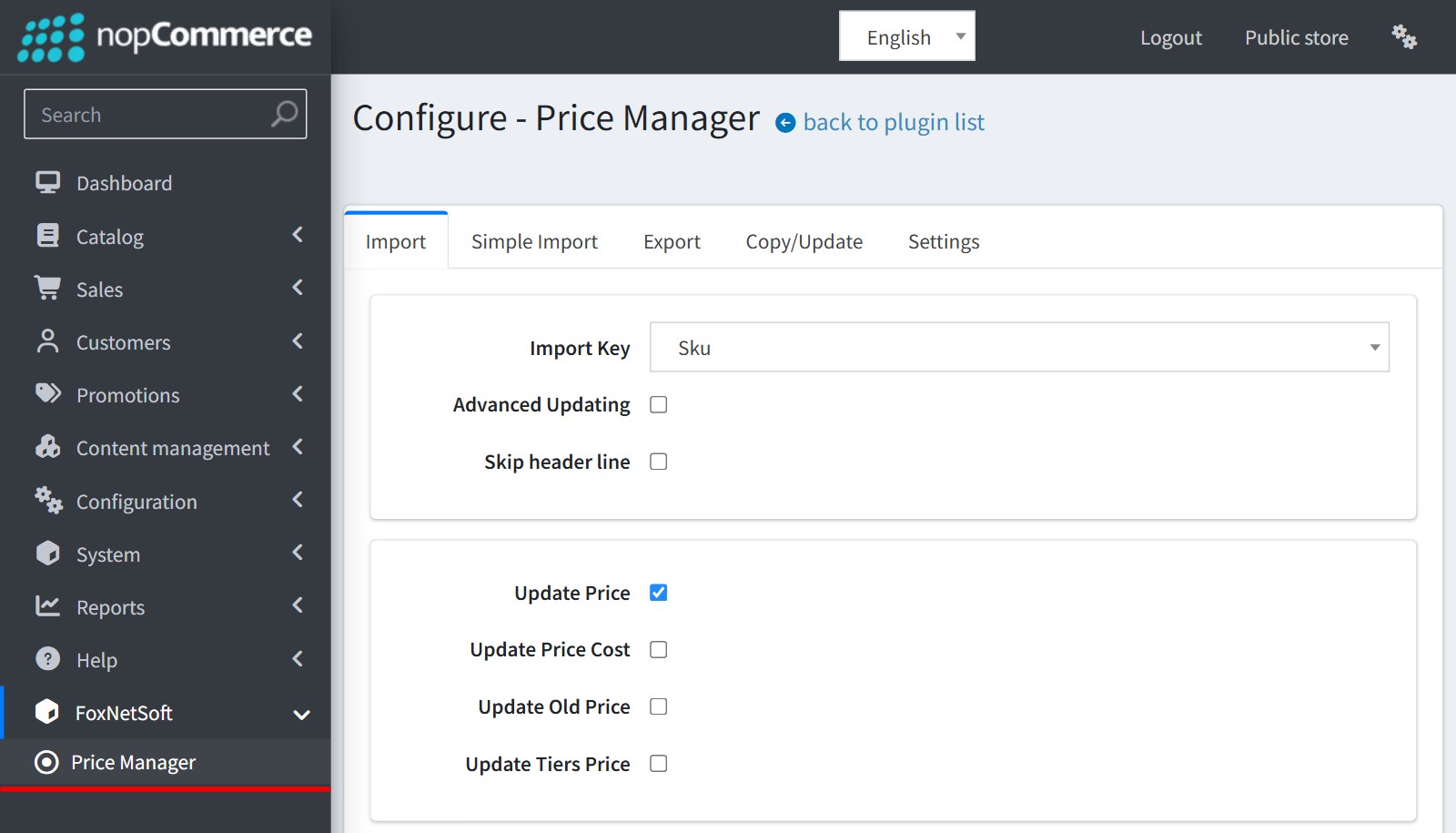
2. The 'Import' tab loads a full price list from a CSV file.
'Import Key' says how the plugin finds a product: Id, Sku, Gtin or ManufacturerPartNumber. Id only works in the same store. For a file from a supplier or from another store use Sku, Gtin or ManufacturerPartNumber.
Tick 'Skip header line' if the first row of your file has the column names.
'Update Price', 'Update Price Cost', 'Update Old Price' and 'Update Tiers Price' say which prices will change. The other columns of the file are not used.
Choose the file in 'CSV file' and press 'Import'.
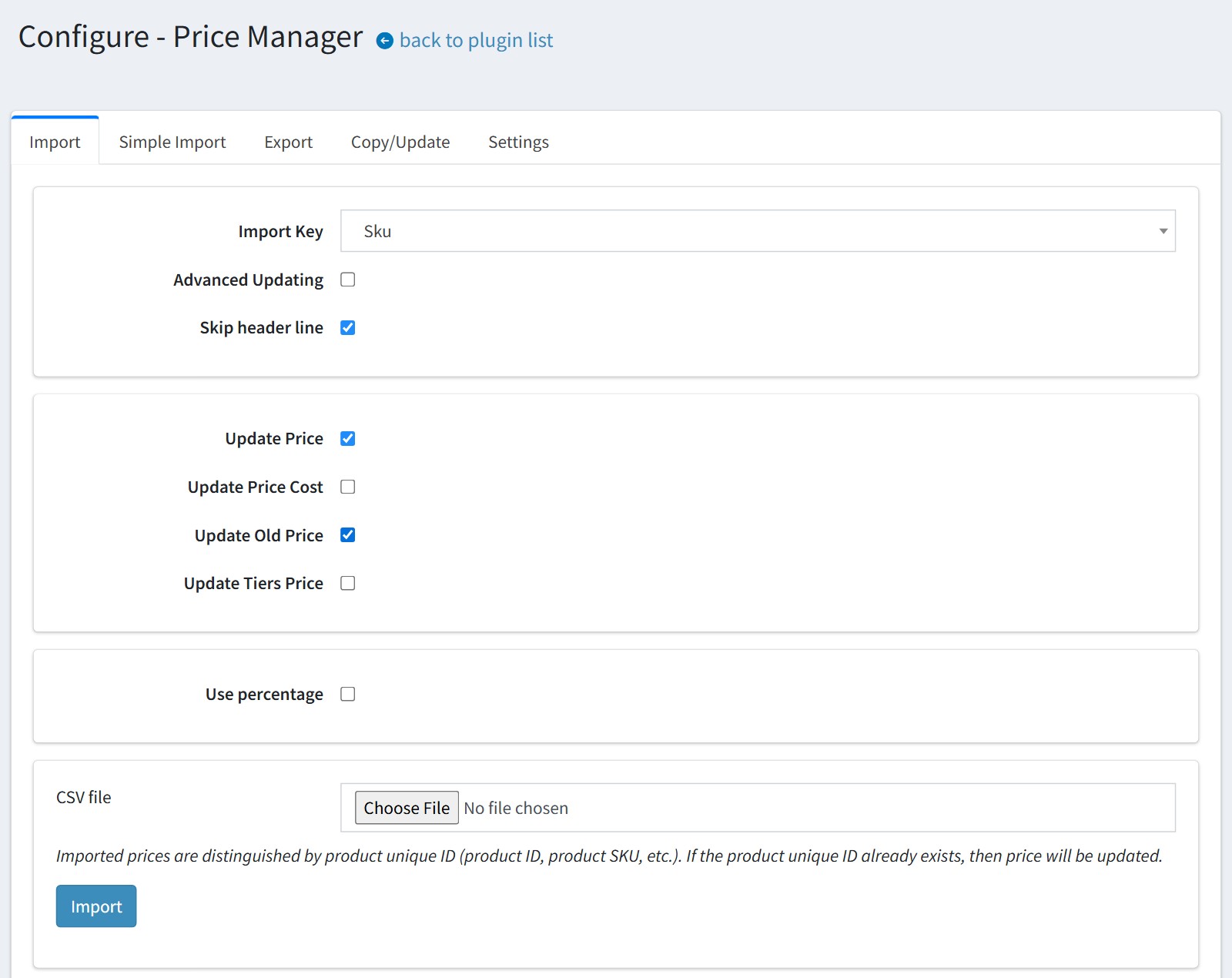
The file has this format. The first column is the value of your 'Import Key'.
Key,Price,ProductCost,OldPrice,TierPricePairs
The older format with eight columns still works too. The plugin reads the key from the first column and does not use the next three columns.
Key,Sku,Gtin,ManufacturerPartNumber,Price,ProductCost,OldPrice,TierPricePairs
Use a dot as the decimal separator: 1245.12, not 1245,12.
TierPricePairs is one string that begins with { and ends with }. Only Quantity and Price are required.
{Quantity:Price:CustomerRoleId:StoreId:StartDate:EndDate;Quantity:Price; ... }
CustomerRoleId 0 means all customer roles, StoreId 0 means all stores. The dates have the format dd/MM/yyyy or yyyy-MM-dd HH:mm:ss.
Examples:
ABC-100,43.5,20,55
ABC-100,43.5,20,55,{3:40;6:38;10:35;}
The second row also sets three tier prices: 40 for quantity 3, 38 for quantity 6, 35 for quantity 10.
ABC-100,43.5,20,55,{3:40:1;10:35:3:2:30/06/2028;}
The third row sets 40 for quantity 3 and customer role 1, and 35 for quantity 10, customer role 3, store 2, from 30/06/2028.
If the row has tier prices, it must have all five columns. Otherwise the tier prices are not read.
'Remove old tier prices' appears when you tick 'Update Tiers Price'.
If you use Sku, Gtin or ManufacturerPartNumber and a product isn't found, the plugin also looks in the attribute combinations and updates the price of the combination.
After the import the message shows how many prices were updated. A row with a wrong value is skipped and the message lists its number. A row with a key that isn't found in your store is ignored without any message, so compare the number with your file.
This document can help you to create the CSV file.
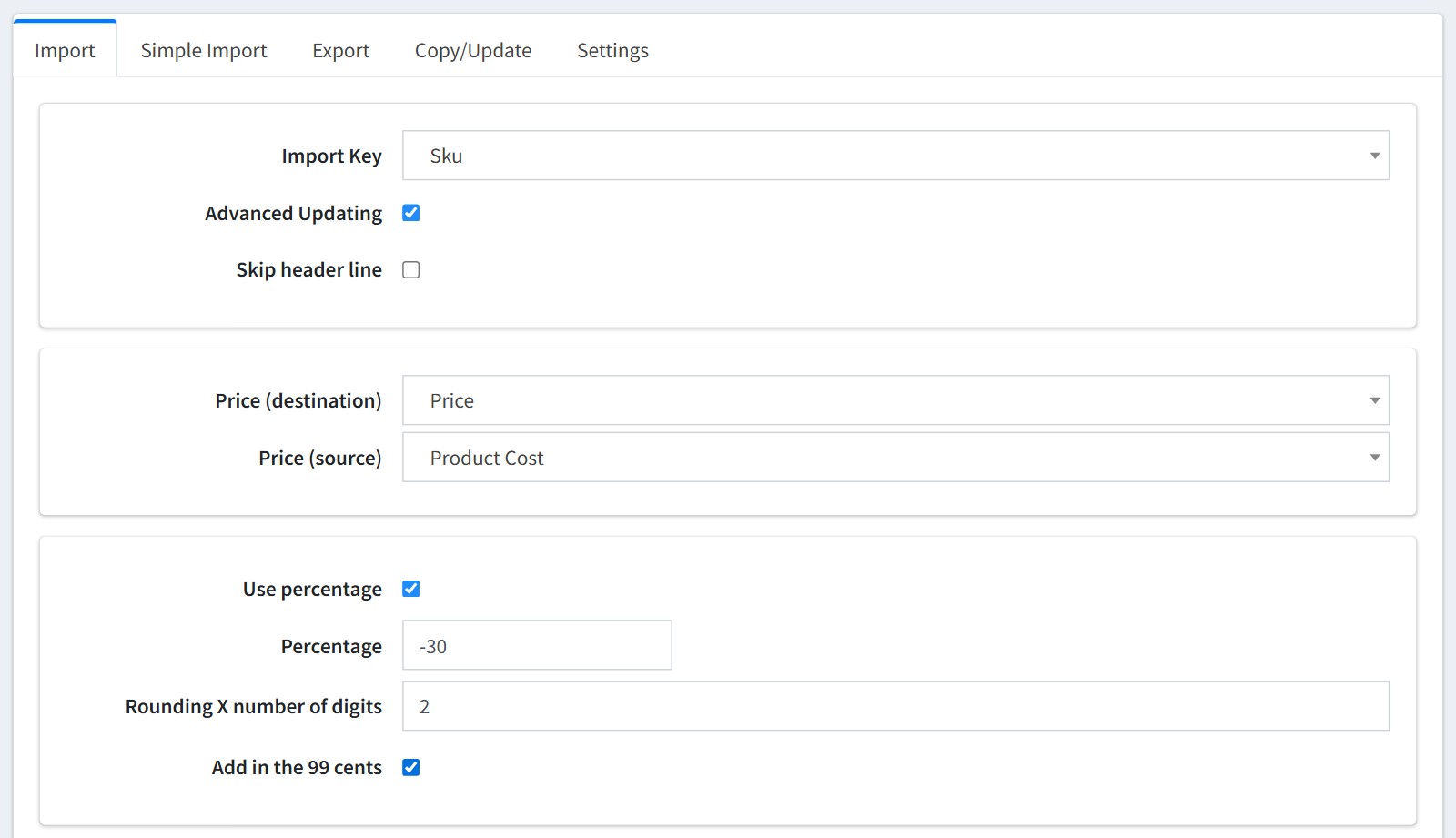
3. 'Advanced Updating' on the 'Import' tab reads one column of the file and writes the result to another price.
'Price (source)' is the column of the CSV file. 'Price (destination)' is the price of the product.
'Use percentage' and 'Percentage' change the value. New price = source x (1 - Percentage / 100). A positive percentage lowers the price, a negative one raises it.
'Rounding X number of digits' rounds the new price.
'Add in the 99 cents' keeps the whole part and ends the price with .99. In this case the rounding is not used.
In the picture the selling price is the supplier cost + 30 %: a cost of 100 gives the price 130.99.
'Use percentage' works only with 'Advanced Updating'. A normal import writes the values of the file as they are.
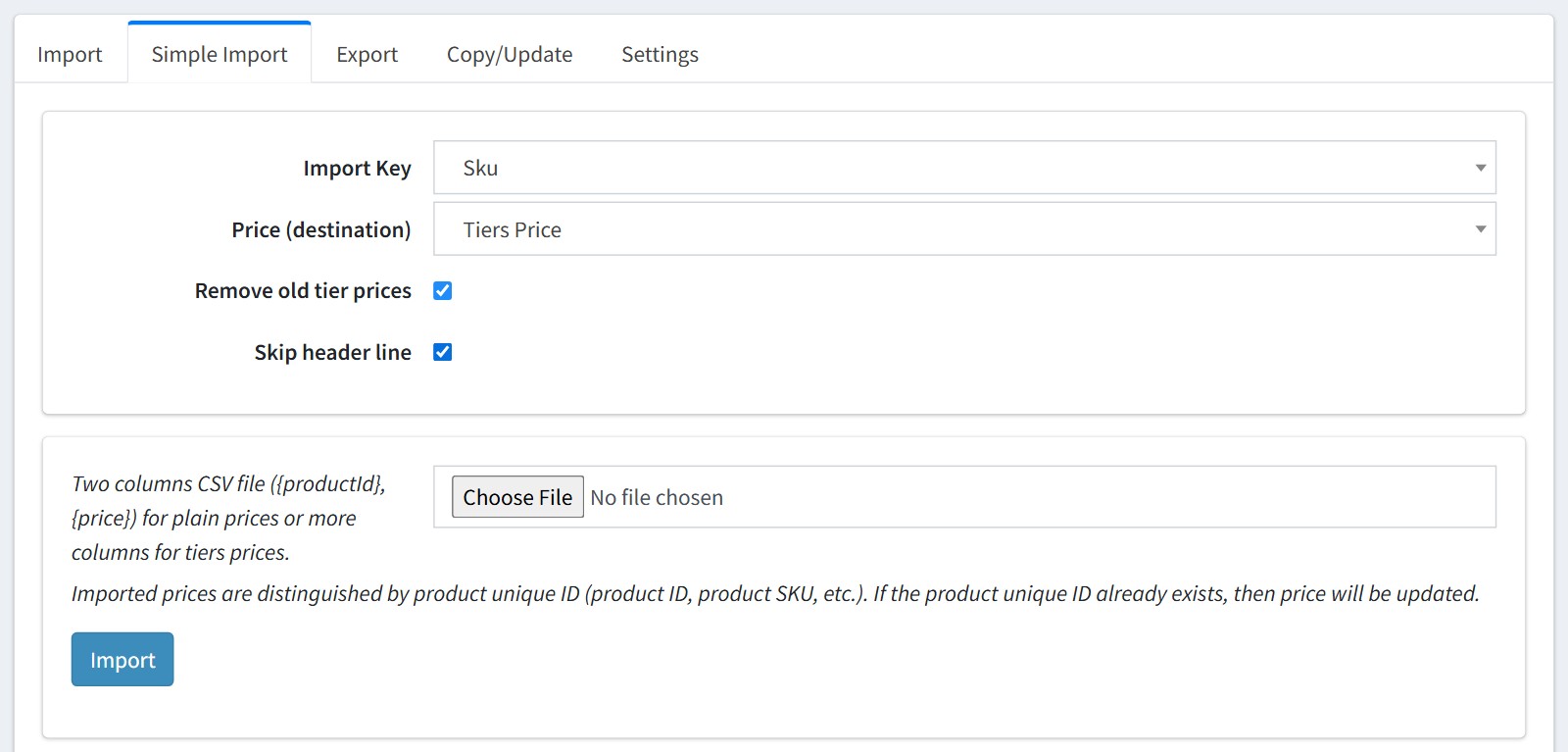
4. The 'Simple Import' tab is for a short file with one price.
'Import Key' finds the product. 'Price (destination)' says which price the file changes: Price, Product Cost, Old Price or Tiers Price.
The file for a plain price has two columns:
ABC-100,12.25
For tier prices you can use two formats. The first one has two columns:
ABC-100,{3:40;6:38;10:35;}
ABC-100,{3:40:1;6:38:1;10:35:3;}
The second one has one tier price in each row, from three to seven columns. Quantity comes before price:
Key,Quantity,Price,CustomerRoleId,StoreId,StartDateTime,EndDateTime
You can skip the last four columns.
ABC-100,8,12.25,6,1
This row means quantity 8, price 12.25, customer role 6, store 1.
'Remove old tier prices' clears the old tier prices of the product before the new ones are added. The tier prices you didn't load will be gone.
5. The 'Export' tab saves the prices to a CSV file.
'Export Key' is the first column of the file.
'Export extra parameters' adds the product name and the admin URL, and more product data, so the file is easier to read.
'Create header line' writes the column names in the first row.
'Export Price', 'Export Old Price', 'Export PriceCost', 'Export product combination price' and 'Export Tier Prices' say which prices go to the file. Combination prices need a key other than Id.
'Tier Prices format' is 'All tier prices in one row' or 'Each tier price in new row'.
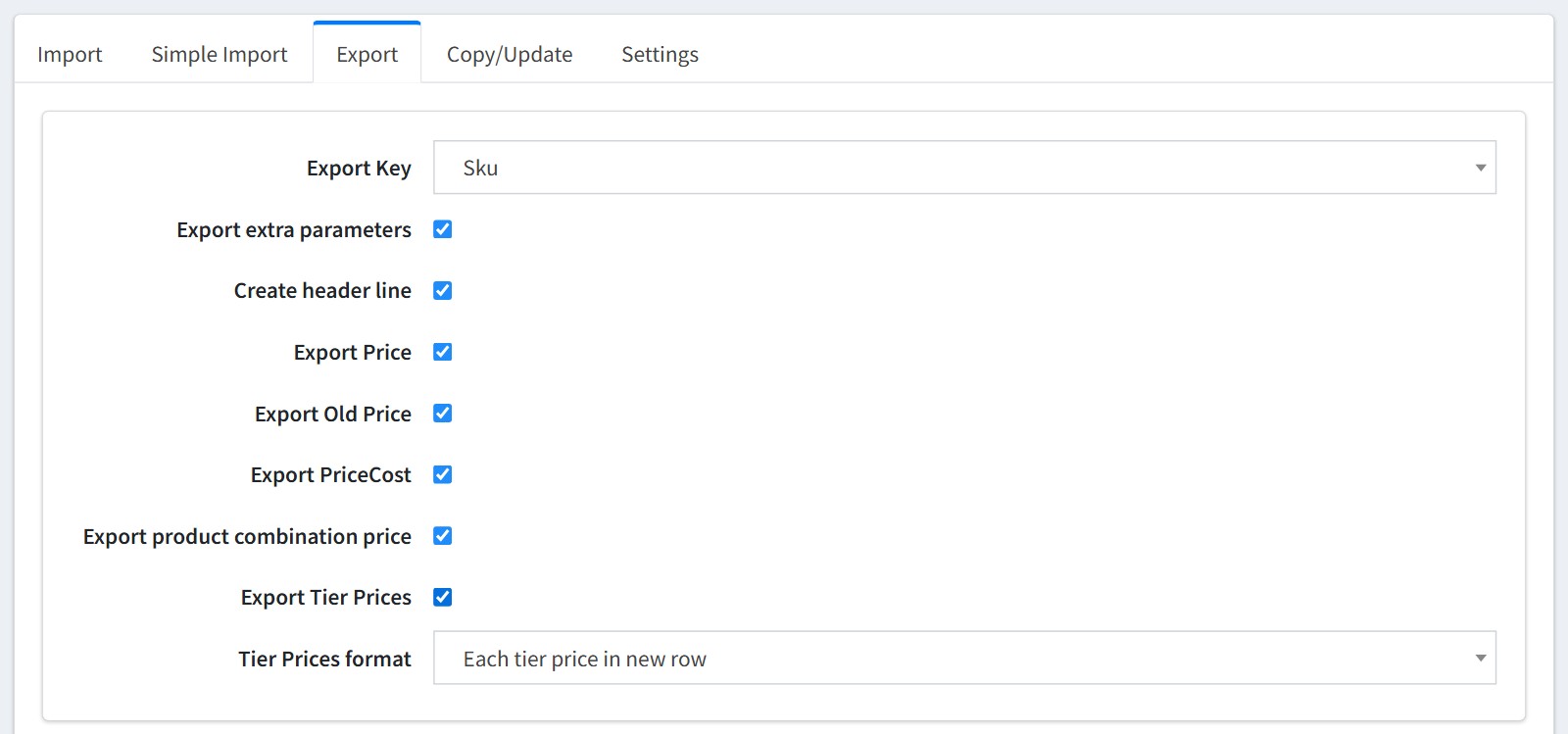
Import reads the columns by their position. If you want to edit the exported file and import it back, tick 'Export Price', 'Export PriceCost' and 'Export Old Price', use 'All tier prices in one row', and don't tick 'Export extra parameters'.
6. 'Select filters for getting products' says which products go to the file: product name, category with its subcategories, manufacturer, vendor, store, product type, published state, product specification and its option, available for sale, and the creation date.
Press 'Export' and the browser downloads the file.
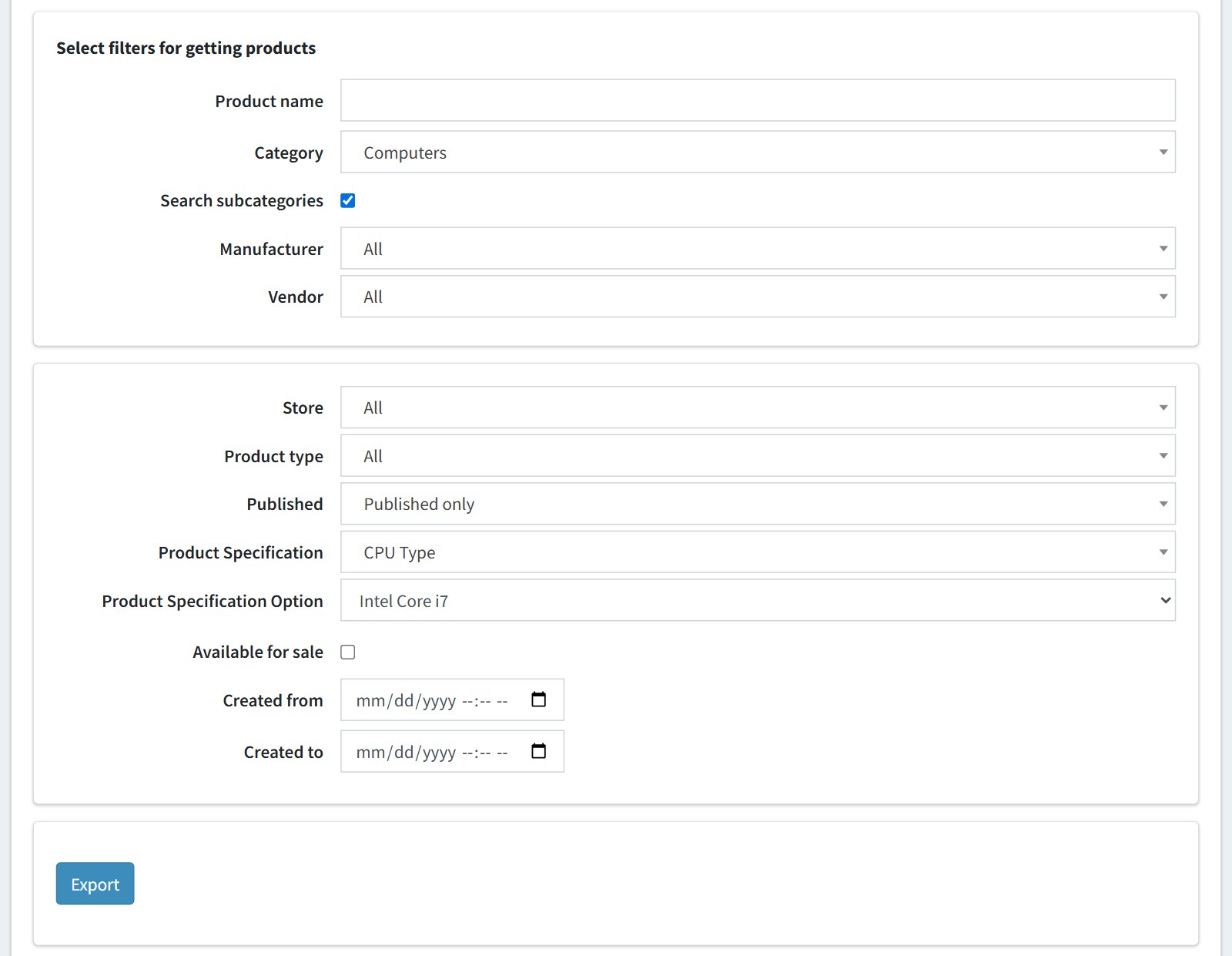
7. The 'Copy/Update' tab changes prices without a file. First choose the products with the same filters as on the 'Export' tab.
There is no preview and no undo. 'Update prices' changes every product that matches the filters at once, so export your prices first and check the filters.
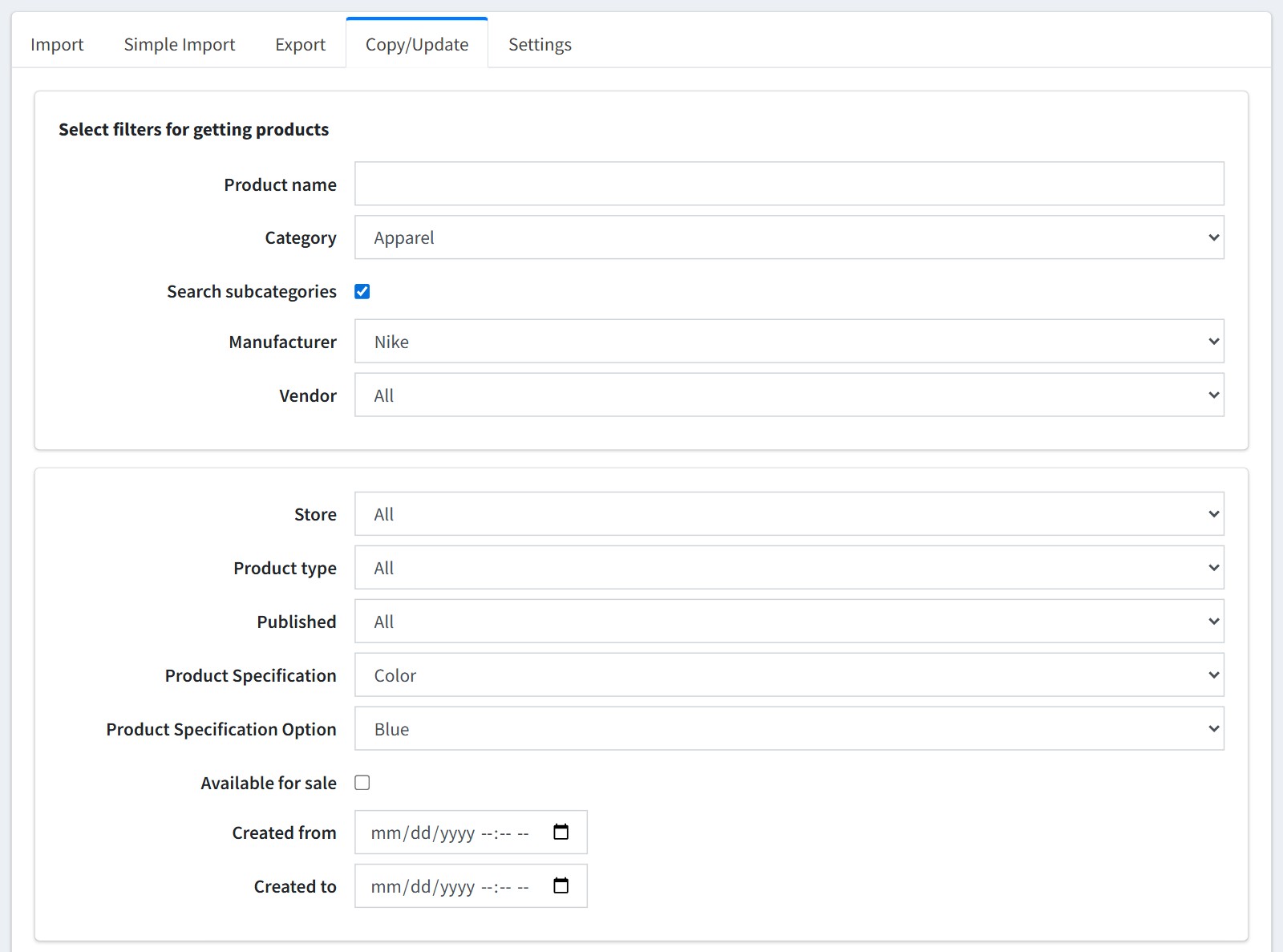
8. Copy one price to another. Choose 'Price (destination)', tick 'Use another source for updating price' and choose 'Price (source)'.
In the picture the old price gets the value of the current price, for example before a sale.
'Price (destination)' can also be the price of the attribute combinations or the price adjustment of the product attributes.
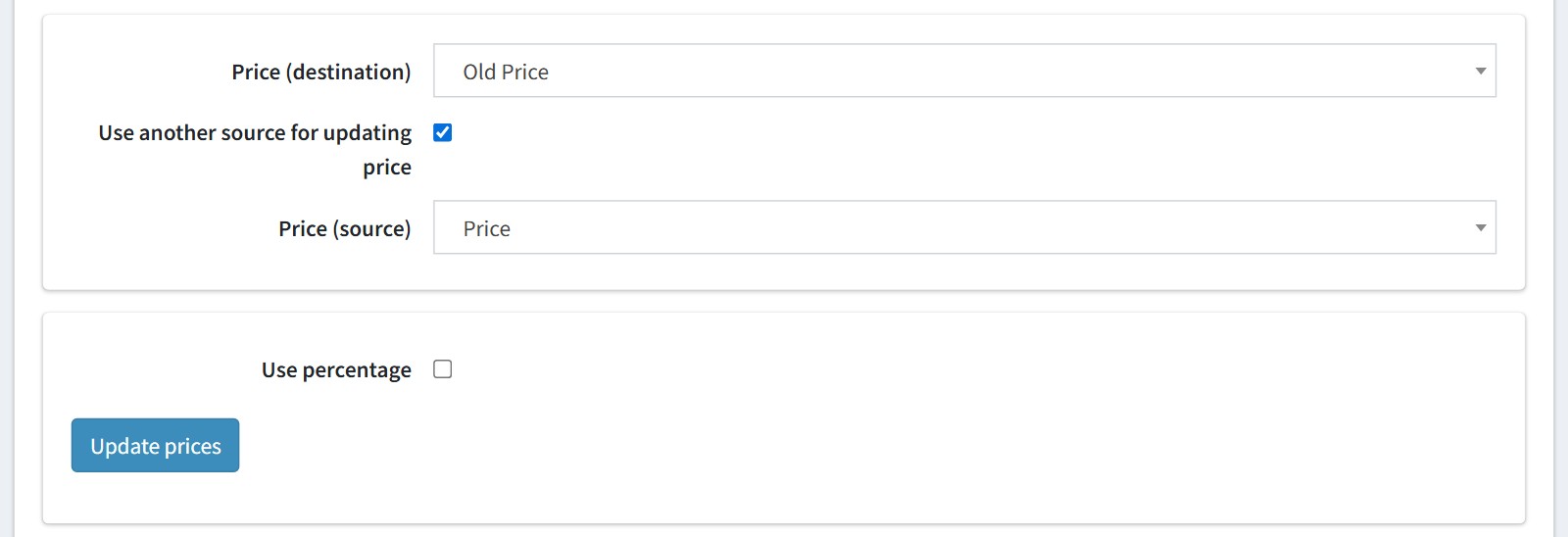
Be careful with 'Use percentage'. If 'Use percentage' and 'Use another source for updating price' are both off, the field 'Amount' appears and all the selected products get this fixed price.
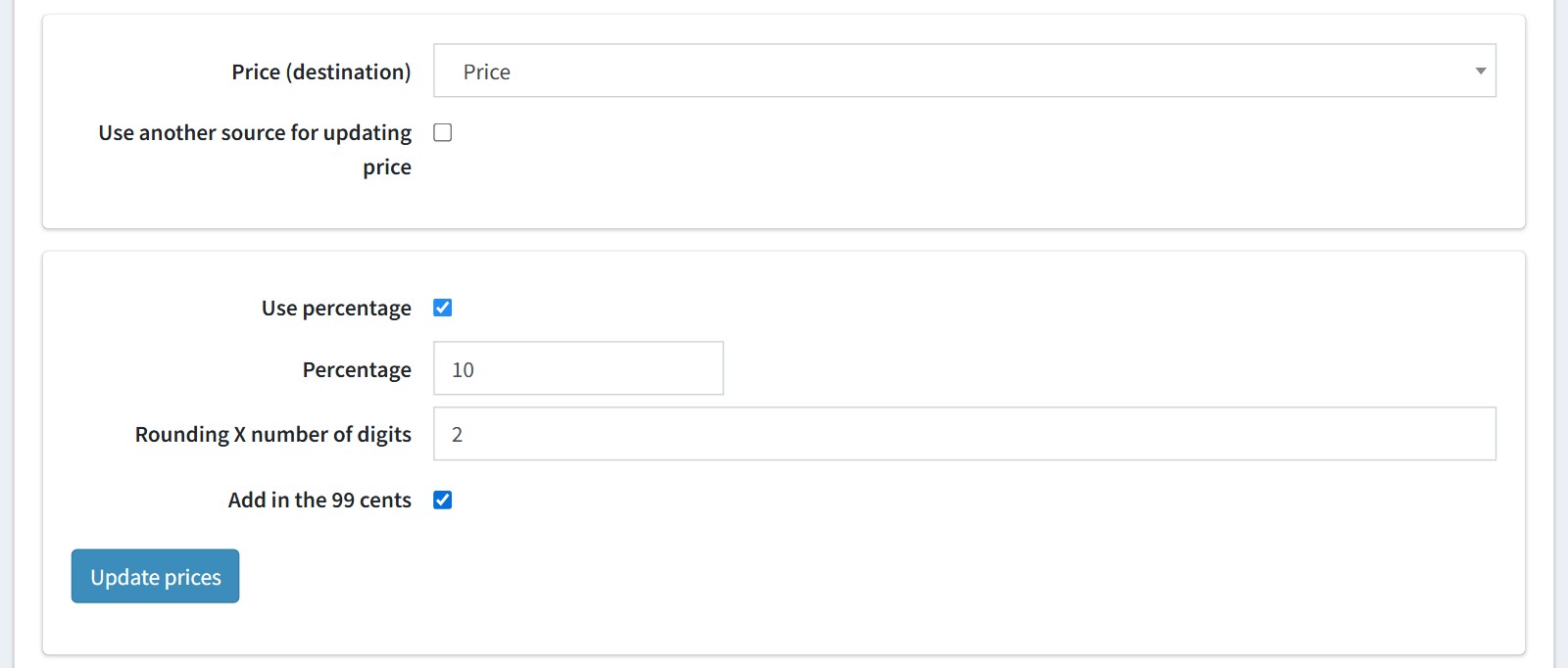
9. Change prices by a percentage. Tick 'Use percentage' and enter 'Percentage'.
A positive percentage lowers the price, a negative one raises it. Use 10 for 10 % off, and -10 for 10 % more.
In the picture the prices go down by 10 % and end with .99: a price of 19.50 becomes 17.99.
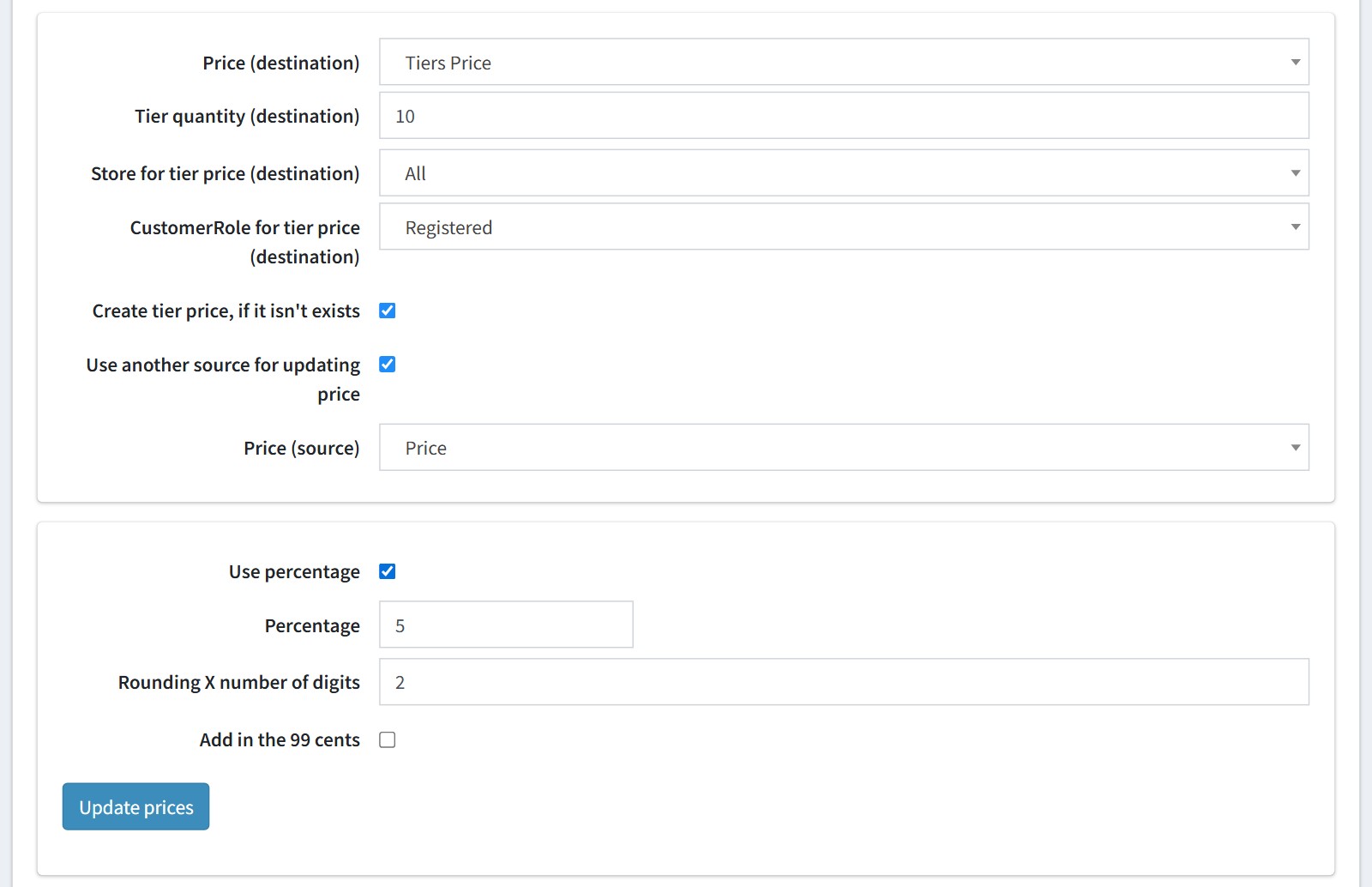
10. Create or update tier prices. Choose 'Tiers Price' in 'Price (destination)' and set 'Tier quantity (destination)', 'Store for tier price (destination)' and 'CustomerRole for tier price (destination)'.
Tick 'Create tier price, if it isn't exists', otherwise only an existing tier price with the same quantity, store and role will change.
In the picture registered customers get a tier price for 10 items at 5 % below the product price: a price of 100 gives the tier price 95.
11. Good to know.
The 'Settings' tab has your 'Serial number'. Without it the plugin works in trial mode and handles only the first 50 products or CSV rows in each run.
Every operation runs when you press the button. The plugin has no schedule and it adds nothing to the storefront.
A vendor can export and change only the products of this vendor. Import and update also need 'Allow vendors to import products' in the vendor settings.